
OELPA
English Language Learners
There is a growing population of students in the area where English is not the language spoken at home. This can make it difficult for students to understand the information presented in the classroom. We are here to help! Please call our TESOL teacher, Debbie Erwin, at 937-743-8601 or by email at derwin@franklincityschools.com
FCS English Learner District Plan
Franklin City Schools ELL Handbook: Screening, Identifying, Placing, Supporting, Testing and Exiting English Language Learners
Prepared by Debbie Erwin, District ESL coordinator
Updated August 2025
The district plan follows state and federal guidelines in providing service to English Learners (ELs)
EL Federal Definition
According to Section 25 of Title IX of the Elementary and Secondary Education Act of 1965, the term English Learner is an individual
A. who is aged 3 through 21;
B. who is enrolled or preparing to enroll in an elementary school or secondary school;
C. (i) who was not born in the United States or whose native language is a language other than English;
i. who is a Native American or Alaska Native, or a native resident of the outlying areas
ii. who comes from an environment where a language other than English has had a significant impact on the individual’s level of English language proficiency; or
iii. who is migratory, whose native language is a language other than English, and who comes from an environment where a language other than English is dominant; and
D. whose difficulties in speaking, reading, writing, or understanding the English language may be sufficient to deny the individual—
i. the ability to meet the State’s proficient level of achievement on State assessments described in section 1111(b)(3)
ii. the ability to successfully achieve in classrooms where the language of instruction is English; or
iii. the opportunity to participate fully in society.
The U.S. Department of Education published the following support materials to outline guidance for serving English Learners in a public school setting.
Dear Colleague Letter
US Dept of Education Letter
English Learner Toolkit
EL Definition from Ohio’s Department of Education
According to the Ohio Department of Education,
“In Ohio, more than 48,000 English Language Learners (ELL) are enrolled in the state’s elementary and secondary public schools. The term English Language Learner refers to those students whose home or native language is other than English, and whose current limitations in the ability to understand, speak, read or write English impact their effective participation in their school education programs
District Mission Statement
The mission of the Franklin City Schools, a progressive, community-based school district, is to guarantee all students can grow, develop, and learn to their fullest potential by providing a challenging, individualized curriculum; an exemplary, compassionate staff; and a state-of-the-art, safe and supportive learning environment.
Strategic Goals
Goal: Student Performance: The academic achievement of all students in the Franklin City School District will improve as indicated by building/district assessments, standardized tests, the State indicators and an increased number of students passing classes per grade level.
Goal: Student Social Emotional Development: The Franklin City School District will integrate activities and curriculum to promote and increase positive social emotional growth and development of students in order to increase self-esteem, attendance, academic performance, and an awareness of future life goals.
Goal: School Environment: The Franklin City School District will become a safer, more nurturing, educational environment maximizing all the resources effectively and efficiently for all students and employees.
Goal: Communications and Public Relations: The Franklin City School District will utilize a variety of conventional and newly emerging technological means to improve positive communication with all facets of the school community (faculty, staff, parents, and students) the business community, etc.
Goal: Funding: All funding sources will be sought and will be effectively and efficiently utilized to optimally support the mission, goals, and the overall operation of the district.
Goal: Supporting Practices: All practices, endeavors, activities that are planned, performed, sought after, etc. will support the achievement and social/emotional growth endeavors of the students.
Statutes, Policies, and Legal Requirements
The following provide a brief overview of mandates and policies guiding the development of educational services for EL students
Federal Policies
Title VI of the Civil Rights Act of 1964
Title VI, 42 U.S.C. § 2000d et seq., was enacted as part of the landmark Civil Rights Act of1964. It prohibits discrimination on the basis of race, color, and national origin by recipients of federal financial assistance. The Title VI regulatory requirements have been interpreted to prohibit denial of equal access to education because of a language minority student’s limited proficiency in English.
Lau v. Nichols (1974)
The U.S. Supreme Court affirmed the need for school districts to take steps to help limited-English proficient (EL) students overcome language barriers and to ensure that they can participate meaningfully in the district's educational programs. The Court ruled that school districts must provide special services to English Learners (ELLs) so that they have equal educational opportunity. ELLs need language instruction educational programs that allow them to progress academically while they are acquiring English language skills. There are several different program models; however, all include both academic content and English language development components.
Castañeda v. Pickard (1981)
Castañeda requires programs that educate children with limited English proficiency to be based on a sound educational theory; adequately supported, with adequate and effective staff and resources, so that the program has a realistic chance of success; and periodically evaluated and, if necessary, revised.
Plyler v. Doe (1982)
The U.S. Supreme Court ruled that the Equal Protection Clause of the Fourteenth Amendment prohibits states from denying a free public education to undocumented immigrant children. Public schools and school personnel are prohibited from adopting policies or taking actions that would deny students access to education based on their immigration status.
Based on the above documented cases, The U.S. Department of Education (ED) and the U.S. Department of Justice (DOJ) have issued joint guidance to remind state education agencies (SEAs), public school districts, and public schools of their legal obligation to ensure that EL students can participate meaningfully and equally in educational programs. The guidance is available at: Title VI guidance
U.S. Department of Education and Office of Civil Rights (OCR) Mandates for Servicing EL Students
- Districts must identify all EL students who need assistance.
- Districts must ensure that all students who need language assistance are provided the opportunity for participation in an EL program.
- Districts must identify a program in which all ELs have a reasonable chance for success.
- Districts must ensure that necessary staff, curricular materials, and facilities exist and are used properly.
- Districts must annually assess the success of the program and make modifications where necessary.
- Districts must guarantee that students are not being misidentified and enrolled into special education classes based on language.
- Districts must develop appropriate evaluation standards, including program exit criteria, for measuring the progress of students.
- Districts must ensure that parents who are not proficient in English are provided with appropriate and sufficient information regarding the education of their children in a language they understand.
State Policies
The U.S Department of Education and the Ohio Department of Education have identified steps for educating English learners.
- A home language survey is administered as part of the registration process for all registering students whose first or home language is other than English.
- Any student for whom a language other than English is reported must be administered a state approved English language proficiency assessment based on the English Language Proficiency Standards for ELs K to 12 to assess listening, speaking, reading and writing.
- The assessment must be conducted by qualified personnel trained in the administration of the assessment instrument.
- Any student who achieves a score that is lower than the eligibility cut off score in listening, speaking, reading and writing established by the assessment is identified as an EL.
Roles and Responsibilities
Parents/Guardians
Complete Home Language Survey
Give written permission to participate in / refuse the EL Program
Attend and participate in the conferences about your child’s educational programs
TESOL Coordinator
Assist in enrolling the student if needed
Administer placement tests
Administer OELPA
Work with all stakeholders to ensure a proper education is being provided
Provide standards-based instruction in small group setting to enhance classroom instruction
Classroom Teacher
Differentiate and scaffold in order to meet the needs of the child
Provide appropriate materials and instruction based on the the students proficiency level
Ensure that appropriate accommodations are given for district/state standardized tests Follow Ohio regulations regards administration of state standardized tests
EL Identification & Program Enrollment
Under Title III, part A of the Elementary and Secondary Education Act, there are three assessment requirements for English Learner (EL) Students:
- Test to determine language skills.
- Yearly language test to measure development and progress of English proficiency.
- Testing to measure students’ progress in meeting State learning
Language Usage Survey
Districts and community schools use the Language Usage Survey to identify students’ language experiences and educational backgrounds, as well as the communication preferences of parents and guardians.
Assessing English Language Proficiency
After identifying potential English learners with the language usage survey, schools assess these students’ English language proficiency using the Ohio English Language Proficiency Screener (OELPS). The OELPS is the state-provided, standardized tool for determining whether students qualify as English learners eligible to participate in the school’s language instruction educational program
Next Steps
Notify parents of English learner identification and services. If a student is identified as an English learner, the district or school must notify parent(s) or guardian(s) explaining the child’s classification as an English learner and the available services.
Implement language assistance services
After a district or school has identified English learners with the language usage survey and English language proficiency screener, it must determine and implement the language instruction educational program the student will receive.
Annual Language Assessment
State and federal law require an annual assessment of K-12 students identified as English learners to measure their English language proficiency. In Ohio, this is the Ohio English Language Proficiency Assessment (OELPA). Visit the OELPA website for more information.
Ohio English Language Proficiency Assessment (OELPA) Information
Implications of Legislation on EL Programs and Student Performance
Parents and guardians are required to receive a letter of notification regarding their student’s enrollment in the EL program after initial enrollment. Parents and guardians must be informed within 30 days of initial assessment of their child’s English Language Proficiency (ELP) level and EL program options. If initial assessment were given during the summer, parents and guardians must be notified within 14 days after the start of the school year.
Testing Requirements on EL Students
EL students must be assessed annually in ELA and math (grades 3-8) and as prescribed by state regulations in grades 9-12.
There are no exemptions or waivers to excuse EL students from testing. All EL students, regardless of time in the country, must take proficiency/state standards tests (with accommodations).
States may provide accommodations on state mandated assessments for EL students in U.S. schools. In Ohio, EL students may receive a bilingual/word-to-word dictionary and extended time on assessments.
In Ohio, the OELPA (Ohio English Language Proficiency Assessment) administration is arranged yearly through the Ohio Department of Education and local testing departments.
Students cannot test out of EL status until they demonstrate proficiency in all four areas of language development: reading, writing, speaking and listening on the Ohio English Language Proficiency Assessment (OELPA).
Who is Assessed?
A student whose parent or guardian responded to the Language Usage Survey one or more of the questions with a language other than English.
A student who was qualified as EL from another state and transferred into the district.
If additional information becomes available it will be addressed on a case-by-case basis.
Title III LEP/ESL Considerations
Eligibility and placement in the LEP/ESL program may be difficult for potential English Learners due to their unique backgrounds and situations. Our district is dedicated to following certain guidelines in order to utilize ESL services appropriately and effectively.
Observations
- It is possible for a U.S.-born student to be LEP if his or her parents have raised the student using only a home language other than English.
- It is possible that a parent registering a student in a school may have very limited English skills, but the student may be fully proficient in English.
- It is possible that a parent registering a student in a school speaks English perfectly, yet this student may be LEP. This sometimes happens when companies bring employees (who speak English) into the U.S. with their families (who do not speak English).
- It is possible in the case of foreign adoptions for the LEP student to have American parents and an American name.
- It is possible for a student’s home language to be something other than English, yet for the student to be fully proficient in both languages and not require ESL.
Grade placement decisions for newly-enrolled English Language Learners
Regarding grade placement of newly enrolled English Learners (ELs), grade decisions are made at the district level based on the district’s evaluation of the students’ academic records and also taking into account the students’ age. It is recommended that students learning English as a new language be placed in a grade as close as possible to their peers. The reason for this recommendation is that it is important for students to be placed with age peers to meet their socialization needs. The goal should be to place the student in a grade level that is appropriate for his or her age level, and then provide the additional support needed to address the student’s English language acquisition needs.
Students with Disabilities
Students with Disabilities who are also English Learners are entitled to receive ESL services in addition to special education/intervention. ELs with disabilities are serviced in accordance with the provisions of the Individuals with Disabilities Education Act (IDEA). ESL services include assigned classes and push-in/pull-out support. ESL teachers regularly consult with Intervention Specialists to review students' language goals, monitor progress, and adapt services as warranted.
Educational Programs
After a school district has identified LEP students who need assistance, it must determine what kind of special language service program is to be provided, and it must implement the program. In Ohio, there is not a specific type of intervention program that is prescribed. Thus, school districts have the flexibility to decide on the educational approach that is based on theory and practices that effectively meets the needs of their LEP students, leading to academic achievement and timely acquisition of proficiency in English.
Franklin City School District may employ the following Title III LEP/ESL Program:
INDIVIDUAL/SMALL GROUP TUTORING
Franklin City school provides individual or small-group tutoring sessions. Tutors may range from trained professional ESL to volunteers who work under the supervision of specially trained teachers. The tutoring sessions may focus on promoting basic English communication skills or focus on English for academic purposes.
RESOURCES
School districts may purchase resources that assist EL students in acquiring the English Language and academic content. All students eligible for placement in the ESL/LEP Program will work with designated staff. Students will continue to receive such services as they move from grade to grade or progress in the levels of English language proficiency until the conditions of the State Exit criteria are met, or the parents or legal guardian declines program services.
Levels of ELs and Their Meanings
Students learning a new language proceed through different stages or levels of proficiency. Ohio has established five proficiency levels (1-5) to categorize LEP students at different stages of their English language development:
Proficient - The student can work without help in a classroom where English is used for teaching. The student may now exit the English learning program. The child will no longer be treated as an English learner. The student scored any combination of level 4s and 5s on the four tests.
Progressing - The student needs teaching in the English language to be able to work in a classroom where the teacher uses English. The student will continue to receive English language services. The student scored a combination of levels that do not meet the Proficient or Emerging levels.
Emerging - The student is in the beginning stages of learning English. The student will continue receiving English language services. The student scored any combination of level 1s and 2s on the four tests
Two Types of Language
Researcher Jim Cummins differentiated between social and academic language. According to Cummins, students who have developed BICS but not CALP do not lack higher order thinking ability; they simply lack the language to succeed in school. This is especially apparent in the writings of our English Language Learners who are challenged with conventions of English writing, spelling, punctuation, and grammar.
BICS - Basic Interpersonal Communicative Skills
This is social language and develops in 1 – 3 years. This is the day-to-day language needed to interact with other people. ELLs use BICS on the playground, in the cafeteria, on the bus. This language is context based.
CALP – Cognitive Academic Language Proficiency
This is an academic language and takes 5- 7 years to develop. There are general academic words and content specific words. Academic language is context-reduced, especially in the upper grades.
Assessment and Evaluation
Student language acquisition and academic performance progress will be evaluated and monitored through a variety of measures to determine if/when students are making/not making progress to inform instructional support to enable English Learners to reach English proficiency and gain grade level content knowledge. The assessments and tools, such as rubrics, checklists, and classroom assessments, used will help educators develop instructional strategies to best support the EL students’ language and learning.
State Assessments
Kindergarten Readiness Assessment (KRA)
The Kindergarten Readiness Assessment is a tool that teachers will use to get to know your child. It is not designed to rank children by ability, nor is it a tool for identifying students with disabilities or gifted students. This tool is primarily to help your teacher get to know your child in a way that does not interrupt the child’s learning. Teachers may identify and provide English Learners additional, designated supports based on the protocol process.
Third Grade Reading Guarantee
Ohio's Third Grade Reading Guarantee is a program to identify students from kindergarten through grade 3 that are behind in reading. Schools will provide help and support to make sure students are on track for reading success by the end of third grade. The department provides policy guidance, instructional tools, and resources on the Third Grade Reading Guarantee. The Ohio Department of Education created a guidance manual to help school districts, community schools, and chartered nonpublic schools understand the requirements of the Third Grade Reading Guarantee.
Ohio State Tests Grades 3-8
The Ohio State Tests are critical for measuring student learning and ensuring that every English Learner receives a high-quality education. The results from state tests in grades 3-8 on the reading, math, science (grades 5 and 8), and science (grades 4 and 7) provide information about how all ELs are performing based on academic achievement linked to the Ohio’s Learning Standards in all four content areas.
End-of Course Tests in the following High School Courses Grades 9-12
End-of-course tests in English Language Arts I and II, Algebra I, Geometry (or integrated mathematics I and II), Biology, American History, and American Government.
Ohio English Language Proficiency Assessment (OELPA)
The OELPA is an English language proficiency assessment. The OELPA is composed of four tests which measure a student’s skills in four key domains (listening, reading, writing, and speaking). OELPA assessment system measures growth in English language proficiency based on the English Language Proficiency (ELP) Standards. It provides valuable information that informs instruction and facilitates academic proficiency in English to help make sure all ELs are making gains in acquiring the English language.
District Level Assessments Test Accommodations for LEP Students
The Ohio Department of Education lists specific accommodations for all state testing for students who are classified as LEP in EMIS. These tests may include, but are not limited to, the AIR Tests of English Language Arts, Math, Science and Social Studies and the Ohio English Language Proficiency Test (OELPA).
Currently, no accommodation is made regarding the length of time a student has been in U.S. schools. Available accommodations for each test may be found on the Ohio State Testing Portal online.
LEP students who are on an Individual Education Plan (IEP) may have additional accommodations based on that plan.
For further information about testing accommodations, please visit the Ohio Department of Education.
Reclassification and Exit Criteria
Each year EL students take the Ohio English Language Proficiency Assessment (OELPA) to monitor their progress in speaking, listening, reading and writing. Exit Criteria from the EL Program is listed as follows:
A student is reclassified (no longer identified as an English learner) and will exit the LEP Program when the student has attained a performance level of Proficient on OELPA. The Proficient performance level is defined as performance levels of 4s and 5s in any combination across all four tests (Listening, Reading, Writing and Speaking). For example, Listening = 4, Reading = 4, Writing = 5, Speaking = 4.
Students in grades K-12 are eligible for reclassification if the student receives a performance level of Proficient.
A student who has an invalidated test or did not test cannot receive a Proficient level even if the other three tests have all 4s and 5s; the student will receive the Progressing based on those levels.
Students exiting from EL status must be monitored for at least two years to ensure that they have not been prematurely exited and they are meaningfully participating in the standard program of instruction comparable to their peers that have not been previously identified as an English Learner.
Family Reports
School districts have an obligation to provide meaningful communication with parents in a language they can understand. Parents will receive a letter from the school district indicating the results of the OELPA Assessment. A Family Report will also be sent.
Definition of Terms
Basic Interpersonal Communication Skills (BICS) Conversational language skills needed in social situations consisting of the day-to-day language needed to interact socially. English language learners (ELs) employ BIC skills when they are on the playground, in the lunchroom, playing sports and talking on the telephone. Social interactions are usually context embedded and are not very demanding cognitively. These language skills usually develop within six months to two years after arrival in the U.S.
Cognitive/Academic Language Proficiency (CALP) level of proficiency required by an EL to understand academically challenging subject matter in a classroom setting. This refers to language that is often abstract, and is not accompanied by any contextual supports such as gestures or visual signals. It may take an EL about 4 to 7 years to reach this level of fluency. English Language Learner A student who is in the process of learning English as a second/additional language. While these students should all be designated as ELLs by schools, educators may find ELLs who are designated as fully English Proficient (FEP) by local exit criteria after demonstrating ability to effectively participate in the standard education program. English Language Proficiency
(ELP) Assessment A test that measures the English language (reading, writing, speaking, and listening) skills of students with limited English proficiency. Such a test is required by Title III of the Elementary and Secondary Education Act (reauthorized as the No Child Left Behind Act of 2001) for all schools served by the state educational agency in every state. English Language Proficiency (ELP) Standards Principles or criteria for identifying and describing the English‐language oral, reading, and writing skills that are necessary for ELLs to be able to communicate effectively and participate fully in school. In Ohio, the ELP Standards are assessed on the OELPA.
Limited English Proficient (LEP) A national origin minority student whose native language is one other than English and who is in the process of acquiring English as a second language. Native Language Primary or first language acquired by the student.
Ohio English Language Proficiency Assessment (OELPA) Annual state language assessment of Limited English Proficiency Students to measure English Language Acquisition progress in the areas of Reading, Writing, Listening, Speaking and Comprehension.
Reclassification Involves the change of service code assigned to EL students in order to more appropriately meet their academic needs, and reflect the levels of acquisition of English as a second language.
Teaching English to Speakers of Other Languages (TESOL) An Ohio Department of Education endorsement requirement under the Teacher Licensure standards to teach EL students enrolled in the LEP Program.
Resources
From the Ohio Department of Education
Lau Resource Center for English Learners | Ohio Department of Education
Guidelines for Identifying English Learners | Ohio Department of Education
Teaching English Learners | Ohio Department of Education
Characteristics of Programs Serving EL Students in Ohio
Ohio English Language Proficiency Assessment (OELPA)
English Learner Exit Criteria | Ohio Department of Education
From the United States Department of Education
English Learner Handbook
Revised March 2025
Statement of Purpose: Under Title III, districts and schools are required to have an English Learner Handbook to address the program, the district approach for services, human resources, student demographics, program policies, Title III fund uses, and evidence of the program’s effectiveness.
Vision and Goal: The vision of the Board of Education is that: our district will work in partnership with families and the community to educate all individuals to be responsible, lifelong learners who possess the skills, knowledge, creativity, self-worth and ethical values necessary to thrive in a rapidly changing, culturally diverse, global society. In keeping with the vision, the goal of our English Learner program is to provide accommodations, as necessary for the individual, to allow each student to access the curriculum and progress toward a score of “proficient” as measured by the Ohio English Language Proficiency Assessment (OELPA) in order to successfully thrive in the United States.
Mission: The mission of Franklin City Schools is to provide maximum learning so every student is college and career ready.
Learning Objective: By the time that the student exists from the English Language Program, as measured by the Ohio English Language Proficiency Assessment (OELPA), the student will be able to successfully participate in their choice of enrollment in the military, enroll in a secondary education program, or by employed.
Approach to English Language Instruction: Franklin City Schools uses the “Sheltered Instruction Observation Protocol” (SIOP) instructional model. This is a research-based instructional model used to make grade-level academic content comprehensible for English language learners (ELLs) while simultaneously promoting their English language development.
The key components of sheltered instruction are:
- Include a clear content objective in addition to a language objective.
- Focus on key grade-level content standards and the use of the English Language Proficiency Standards.
- Focus on use of the four domains: listening, speaking, reading, and writing.
- Leverage the home language to bridge to English, including use of translanguaging.
- Implement high use of visuals (such as pictures, illustrations, gestures, maps, graphic organizers, and timelines).
- Build background as needed to understand the lesson, especially for Students with Interrupted/Inconsistent Formal Education (SIFE).
- Deliver explicit vocabulary instruction and word learning strategies, such as affixes.
- Coordinate concurrent development of oral language.
- Offer frequent opportunities for student interaction with support.
- Provide regular formative assessment and targeted feedback.
Staff: Currently, the district has 1 English Learner Coordinator, TESOL endorsed. In addition, there are 2 other staff members in the district with TESOL endorsements.
The Coordinator responsibilities include:
- Welcoming new students
- Conducting the OELPS
- Assistance with scheduling
- Some direct instruction
- Compliance
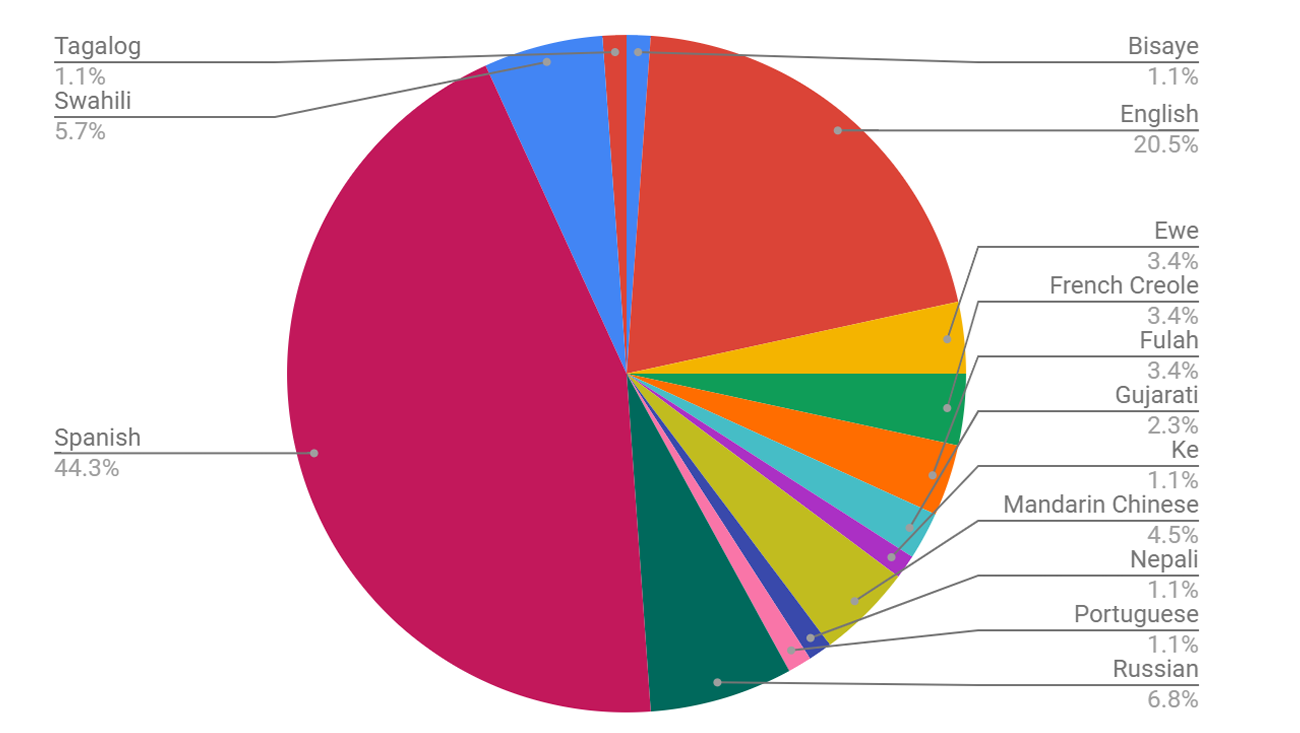
Student Demographics: As of 2024-25, 67 students are being served and an additional 22 are on quarterly monitoring. The home languages are graphed below. Of the 67, three students are newcomers.
Program Policies:
- Method for Identifying and Assessing:
The Ohio Department of Education defines English Learners as “students whose primary or home language is other than English who need special language assistance in order to effectively participate in school instructional programs.” Franklin City Schools identify ELs through our registration process in which a Language Usage Survey is embedded. The results of the survey are validated by the 3 district’s TESOL teacher using Ohio Department of Education Appendix A. If the student is transferring from a school in the United States, records are requested which include the written Limited English Plan and any assessment scores.
If a student is enrolling for the first time in a U.S. school, the Ohio English Language Proficiency Screener (OELPS) is given within 30 days of the enrollment. A Limited English Plan is written specifically for the student based on the results of this assessment. This protocol follows state and federal guidelines. If a student is determined to be EL, the parent/guardian is notified, a meeting is scheduled in which results are shared, and a plan is written. Translation or interpretation is provided as needed. As part of the plan, the parent must sign to either accept or deny services and a copy is retained in the student file. If services are denied, the TESOL-endorsed staff routinely shares instructional strategies to the regular classroom teacher(s).
- Transitioning, Exiting, and Monitoring ELs: ALL EL students are given the online OELPA assessment during the state window that typically begins in February and ends in March. When an EL student has received a composite score of Proficient on the OELPA, the student is exited from the EL program during a parent meeting. The Ohio Department of Education has an exit protocol found here. Per ESEA, Franklin City Schools monitor students exiting from EL status for four years to ensure that (1) they have not been prematurely exited; (2) any academic deficits incurred as a result of participating in the EL program have been remedied; and (3) they are meaningfully participating in the standard program of instruction comparable to their never-EL-peers. (resource: English Learner Tool Kit for State and Local Education Agencies. U.S. Department of Education, Nov. 2016)
- Accommodations and Supports
Franklin City Schools provides a variety of accommodations and supports based on the level of need for the student and the families.
These accommodations include, but are not limited to:
- Testing accommodations
- A chromebook with Google Translate loaded to the device
- Translators for enrollment and meetings
- Communication home sent in the home language
- Flexibility upon enrollment
- Title I instruction (in buildings that are identified as Title I)
- Access to nutrition
- Access to information translated in the home language of community supports
- Annual Family Engagement Student Resource Expo Fair
- Students who have exited the program are monitored quarterly for four years
- Sample English Learner Plan.pdf
- Initital Parent Notification Letter.pdf
- Parent letter of ELL Registered, Did not qualify.pdf
- ODE Appendix B.pdf 4
- Example of Student Monitoring Docpdf
- Example ELL Continuing Status.pdf
Title III Fund Uses
- Professional Development
- Instructional Materials and Supplies
- Family Engagement Materials and Supplies
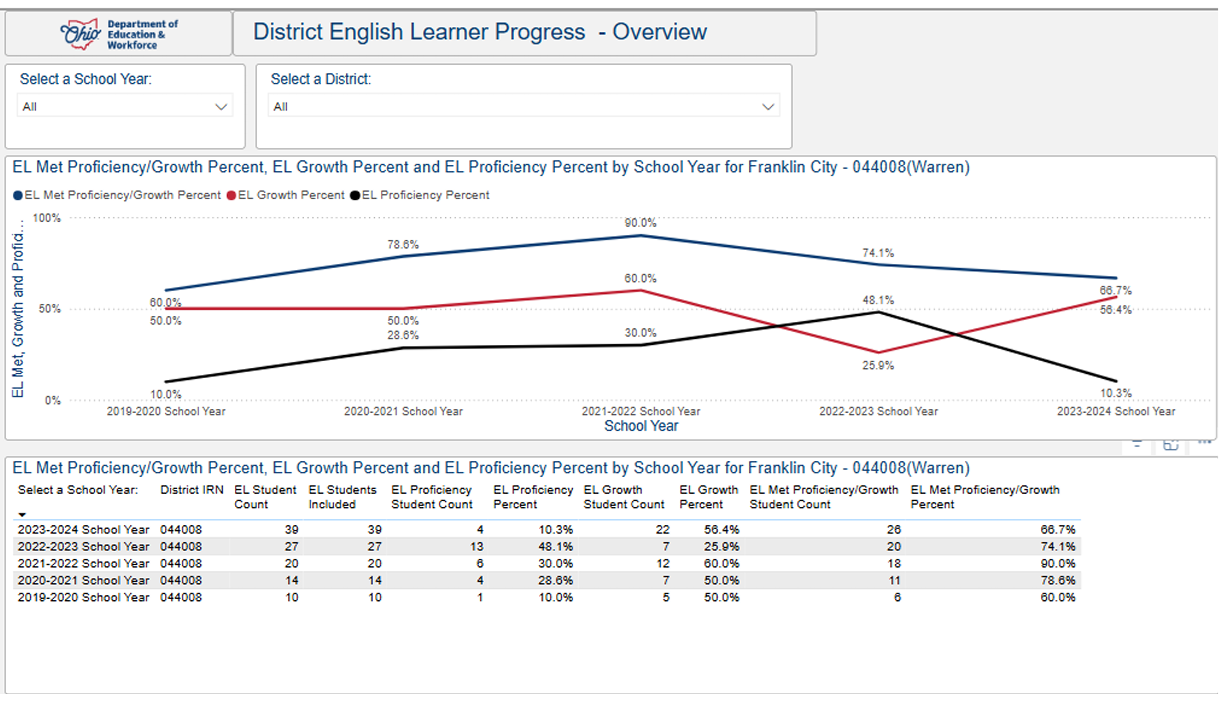
Evidence of Program Effectiveness:
Report Card data is shown below as evidence of effectiveness of the program.
English Learners with Disabilities:
No student at Franklin City Schools is tested for a disability without several documented interventions through the Multi-Tiered System of Support model. Interventions should be tried, tested and changed or modified before a disability is considered. Students with Disabilities who are also English Learners are entitled to receive ESL services in addition to special education/intervention. ELs with disabilities are serviced in accordance with the provisions of the Individuals with Disabilities Education Act (IDEA). ESL services include assigned classes and push-in/pull-out support. ESL teachers regularly consult with Intervention Specialists to review students' language goals, monitor progress, and adapt services as warranted.

We Have Community.
Our district boasts the highest percentage of parent volunteers in the state.
We Have Heart.
We're the only district in the country with a dedicated "Squirrel Crossing Guard" at Oakwood Elementary.
We Have History.
Our district's first schoolhouse was built in 1852 and is now a beloved local landmark.
We Have Success.
We have a 99%+ graduation rate - a testament to our dedicated teachers and motivated students.